
An ISO 9001:2015/ISO 45001:2018/14001:2015 & CE & WHO GMP Certified Company

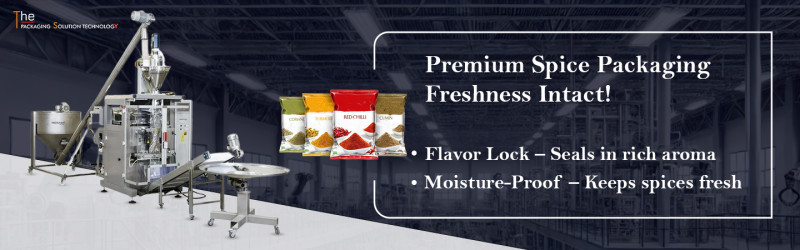
Spice Processing, Packaging & Lamination — Why Modern Spice Manufacturing Is No Longer Just About Grinding Masala
India’s spice industry has changed tremendously over the last decade. Earlier, many spice manufacturers focused mainly on sourcing raw spices, grinding them, and supplying them into the market as quickly as possible. Packaging was treated as the final step, and lamination was often considered just a printing requirement.
But the market today works very differently.
Consumers have become more quality conscious. Retail shelves have become more competitive. Export buyers expect consistency in every shipment. Even local distributors now pay attention to packaging quality, shelf life, sealing strength, and product presentation before making purchasing decisions.
Because of this, modern spice manufacturing is no longer only about producing spice powder. It has become a complete system involving processing, recipe control, packaging technology, and packaging material engineering together.
A spice product now passes through multiple stages before reaching the customer:
cleaning, grinding, blending, storage, batching, pouch filling, sealing, and finally protective laminated packaging.
And the truth is — if even one of these stages is weak, the entire product quality suffers.
One of the biggest changes happening inside spice factories today is the shift toward integrated production systems. Earlier, many manufacturers worked with separate standalone machines. Grinding happened in one area, blending somewhere else, and packaging in another section entirely. Material movement depended heavily on labor. Powders were transferred manually through drums or bags, and recipe accuracy often depended on operator experience.
That model becomes difficult once production scale increases.
When a factory starts producing multiple spice blends every day — garam masala, kitchen king, pav bhaji masala, turmeric powder, chilli powder, coriander powder, seasoning mixes — maintaining consistency becomes much more complicated than most people realize.
Every spice behaves differently during processing.
Turmeric generates different grinding behavior compared to chilli powder. Coriander has different oil content. Some ingredients create more airborne dust, while others absorb moisture quickly during storage. Even temperature variation inside the grinding system affects aroma retention.
This is why serious spice manufacturers are now investing in better production control instead of focusing only on grinding capacity.
The goal is not simply producing more kilograms per hour. The real objective is maintaining the same product quality repeatedly across every batch.
That is where automated recipe batching systems have become extremely important.
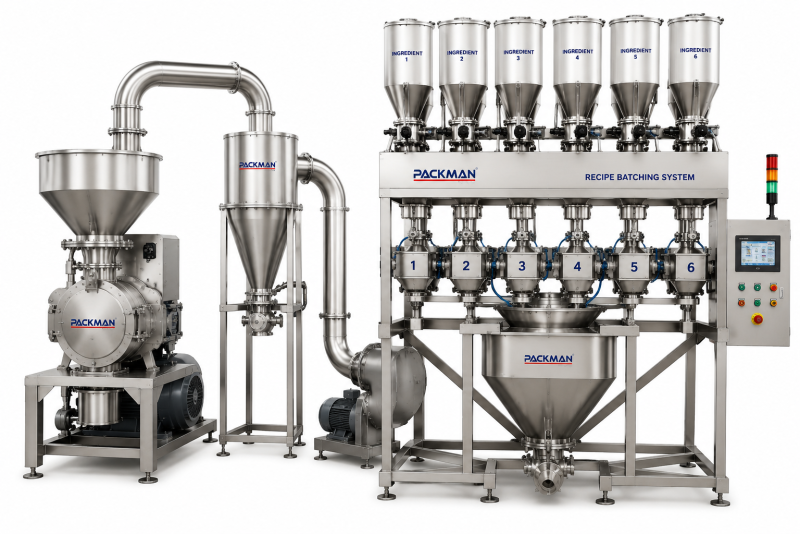
Modern spice plants today are increasingly using recipe-controlled batching systems that automatically weigh ingredients according to predefined formulations. Instead of operators manually measuring raw materials, the system controls ingredient flow digitally using load cells, dosing systems, and automated feeding arrangements.
This becomes especially useful for blended masalas where even a few grams of imbalance can change the taste profile completely.
In many large-scale factories, batching systems are now connected directly with mixers, grinding sections, and storage hoppers to create continuous production flow. Material moves automatically from grinding to storage, from storage to batching, and from batching to the mixer without repeated manual handling.
This improves not only speed but also hygiene and production stability.
One area people outside the industry often underestimate is how difficult powder handling actually is.
Spice powders are extremely sensitive materials.
Fine powders generate dust very easily during transfer. Some materials bridge inside hoppers. Some create inconsistent flow during feeding. Some lose aroma if exposed to excessive heat or air for long durations.
This is why modern spice plants now focus heavily on controlled material handling systems.
Instead of open manual transfer, industries are moving toward:
closed conveyors, screw feeding systems, pneumatic transfer lines, intermediate storage tanks, and controlled discharge systems.
Not only does this improve production cleanliness, but it also reduces product loss significantly.
In high-capacity plants, even small product losses become major financial losses over time.
That is why modern automation is not only about reducing labor anymore. It is also about controlling waste, maintaining consistency, and improving operational efficiency throughout the plant.
But processing alone does not protect spice quality.
Packaging has now become equally important.
A perfectly processed Masala can still lose freshness if the packaging structure is weak.
Spices are highly sensitive to moisture, oxygen, sunlight, and external contamination. If packaging barriers are poor, aroma loss begins quickly. Color quality changes. Shelf life reduces. The product no longer feels premium to the customer.
This is exactly why laminated packaging has become such a critical part of modern spice manufacturing.
Today’s spice pouches are no longer simple plastic bags. Most serious manufacturers now use multilayer laminated structures designed specifically for aroma retention and moisture protection.
Depending on product requirements, packaging films may contain combinations of:
PET, MET PET, BOPP, LDPE, or aluminum barrier layers.
The purpose of these layers is not only appearance. They are engineered to protect product quality during storage, transportation, and retail display.
For export markets especially, lamination quality becomes extremely important because products remain in containers, warehouses, and retail shelves for extended periods.
A weak pouch structure can destroy months of production effort.
That is why modern spice brands now think about packaging material selection much earlier in the production planning stage rather than treating it as an afterthought.
Another major shift happening in the industry is the movement toward complete production integration.
Manufacturers no longer want disconnected machines working independently. They want grinding systems connected with storage systems, batching connected with mixers, and packaging connected with automatic feeding systems.
The idea is to create a stable production environment where material movement becomes smoother and production planning becomes easier.
This becomes especially valuable for factories handling:
multiple product lines,
multiple SKUs,
high daily production,
and export-oriented operations.
Because once production scale increases, operational efficiency becomes just as important as machine speed.
At Packman Engineering, the focus is not only on supplying individual machines but on understanding how the complete spice production flow works in real factory conditions — from grinding and batching to packaging and laminated pouch handling.
Because modern spice manufacturing is no longer about simply making masala.
It is about maintaining flavor consistency, protecting aroma, improving shelf life, reducing production losses, and delivering a product that feels reliable every single time the customer opens the pouch.
And that level of consistency only comes when processing, packaging, and lamination work together as one complete system.
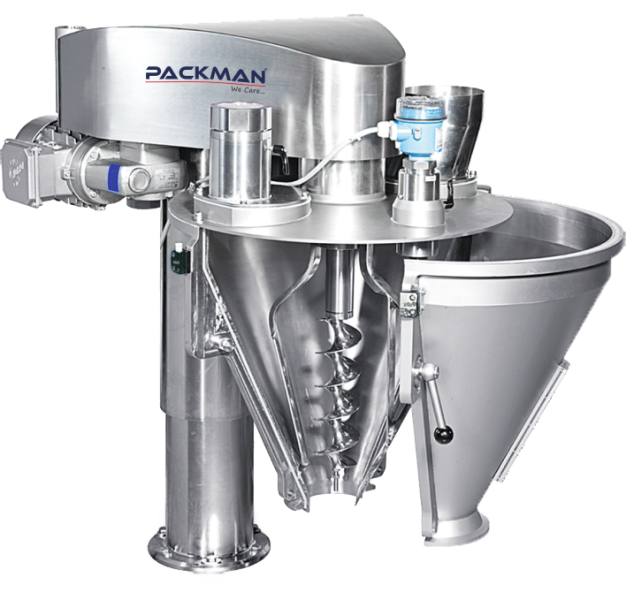
Complete Packaging Solutions for Dehydrated Food ProductsPICK FILL SEAL MACHINE- PACKMAN ENGINEERING The demand for dehydrated food products is increasing rapidly across India and international markets due to their long shelf life, easy storage, and convenience. Products such as dehydrated onion fl ... Continue Reading
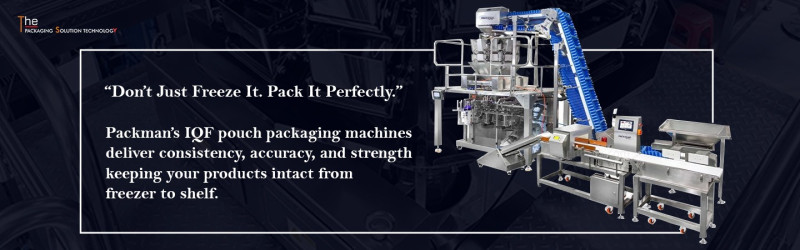
Revolutionizing Frozen Food Packaging with Smart Automation The frozen food industry across Thailand, Vietnam, Malaysia, Indonesia, Singapore, Philippines, Cambodia, Laos, Myanmar, South Korea, Japan, Australia, and the Middle East is experiencing rapid growth. Consumer demand for hygienically pack ... Continue Reading
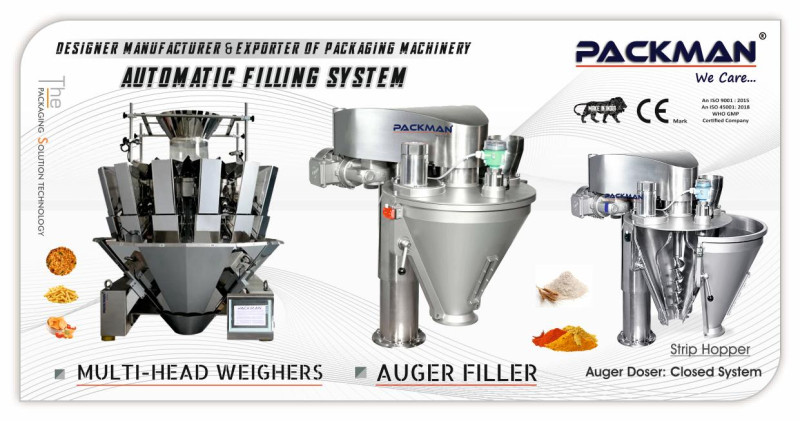
Introduction In today's competitive manufacturing environment, achieving accurate filling and efficient packaging of powders and fine granular materials is essential for maintaining product quality, reducing waste, and maximizing productivity. However, many manufacturers continue to face challenges ... Continue Reading
Complete Turnkey Solutions for the Modern Spice Industry In today’s highly competitive spice industry, producing high-quality spices alone is not enough. Manufacturers must also ensure consistent taste, precise formulations, hygienic processing, high production efficiency, uniform particle si ... Continue Reading